
AI Enhanced
Imagery
Elevate your content, expand your horizons.
Artificial intelligence is no longer a future concept—it has become a practical part of modern image production. After several years of rapid development, today’s AI tools can help streamline workflows, accelerate visual development, and enhance key visuals in ways that would previously require significant time and resources.
As with many technological shifts, the real value lies not in the novelty of the tool, but in how it is applied. While image generation has become widely accessible, creating effective commercial imagery still depends on direction, taste, and production experience. The ability to combine photography, CGI, retouching, and AI into a coherent visual outcome is what turns generated content into meaningful communication.
Rather than focusing on the broader debate around copyright or ethics, this section explores the practical production side of AI: using it to solve visual problems, develop ideas faster, extend creative possibilities, and deliver stronger results for real-world campaigns.

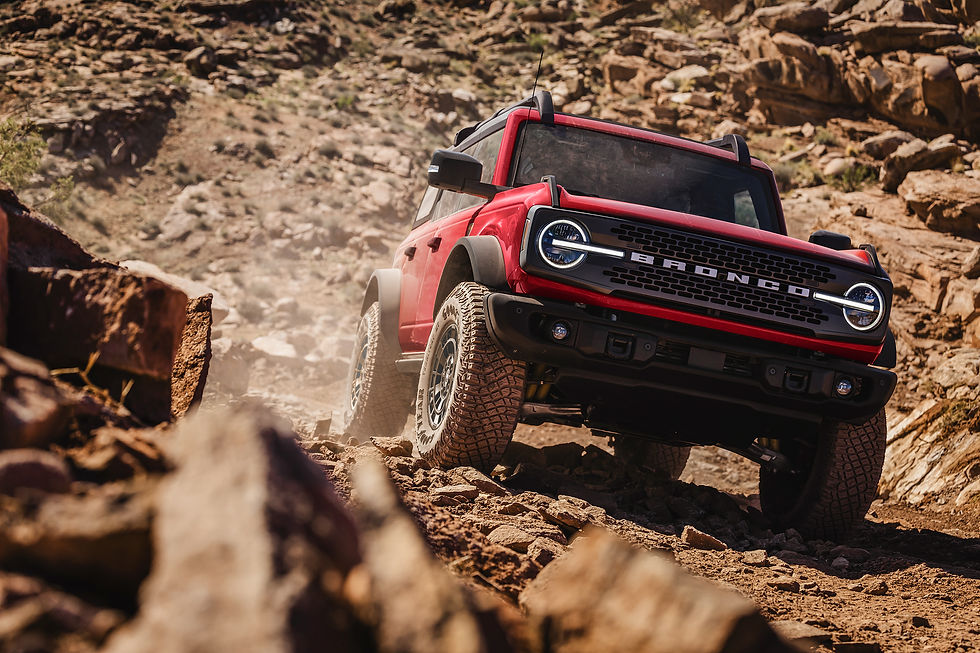
This example demonstrates a practical use of AI within a commercial post-production workflow. The original photograph was captured on location, but the background behind the vehicle was replaced to improve subject separation and create a stronger visual hierarchy.
Additional post-production work was used to integrate the new background, balance colour and contrast, and ensure the final image remained cohesive and believable.
AI did not replace photography or retouching in this workflow, it expanded the creative possibilities and allowed a new visual direction to be achieved quickly and efficiently.


Another part of the same brief was to combine different elements from various versions of the vehicle to create a unified, preferred specification for the campaign. The Bronco is available with multiple options, including mirrors, roof finishes, front bumpers, tyres, rims, badges, and other details. The preferred options were highlighted below in green.

The vehicle photographed on location featured older parts that did not match the current showcase model. Using generative AI, I was able to create replacement elements matching the original camera angle, perspective, and lighting.
These elements were then carefully integrated and retouched, ensuring precise placement and overall visual cohesion. The vehicle colour was also updated to match the current dark green specification.


Even simple objects can become powerful brand assets when paired with a recognisable identity, evoking familiarity and creating stronger emotional connections with the audience. Using generative AI, I was able to seamlessly emboss, stitch, and sculpt the No7 logo onto a range of props, integrating each treatment naturally into the scene.
This approach removes the need to manually create and retouch each branded element, saving production time while making the same props adaptable across different campaigns. A simple workflow that adds flexibility, reduces production costs, and opens up more creative possibilities.


Adding custom elements is now remarkably flexible. By providing a suitable reference and defining the desired asset, multiple variations can be generated, refined, and combined to achieve the right result.
In this example, the client felt the original foundation shot was too understated and wanted to add a liquid product effect dripping down the side of the bottle, inspired by a reference image. Previously, this would likely have required detailed digital painting or a dedicated CGI simulation and render.
Using generative AI, the effect could be developed and integrated in a relatively short time, allowing a last-minute creative change to be accommodated without putting unnecessary pressure on the post-production schedule. It demonstrates how AI can add flexibility to an established workflow, making late-stage creative amends faster and more manageable.

Virtual set extension is a practical example of how AI can streamline production and reduce costs. The original image was captured in the studio, where only a small section of the background set was physically built.
Using generative AI and skilled retouching, I extended the set into a complete panelled wall, carefully matching the original lighting, perspective, and overall campaign mood.
Traditionally, this would have required extensive digital painting or a CGI workflow involving modelling, texturing, rendering, and compositing. AI made it possible to achieve the desired look more efficiently, expanding creative possibilities without the time and resources required to build the entire set physically or in 3D.


